
The Swarm and the Rain: Finding Hope in the Book of Joel
When life feels like one disaster after another, can we really believe in a God who restores what the locusts have eaten?

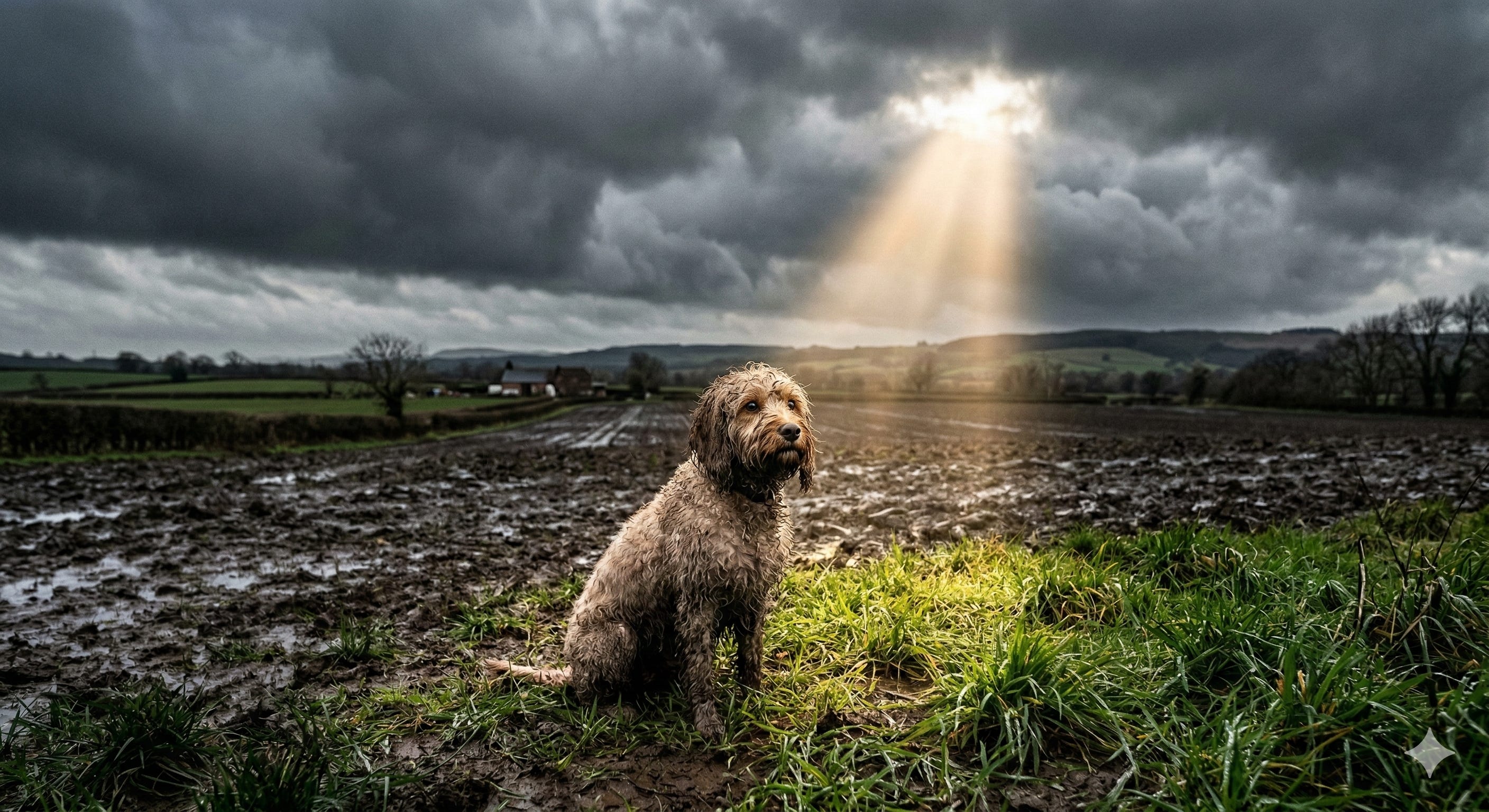
I’ve never been much of a gardener. My better half will tell you that my primary contribution to our outdoor space is “enthusiastic but misguided mowing.” I tend to approach the lawn with a level of intensity that suggests I’m clearing a path through a jungle rather than tidying up a semi-detached plot in the UK.
But even my lack of a green thumb couldn’t shield me from the sheer, damp misery of the last few months. It has been, by all accounts, the wettest season in recorded history—or at least it feels that way when you’re scrubbing dried mud off a Cockapoo for the fourth time in a single afternoon. My dog, Buckley, has reached a stage of permanent dampness where he’s developed a scent I can only describe as “ancient bog.” He looks less like a boutique designer dog and more like a very small, very soggy mop that has lost its will to live.
It was against this backdrop of grey skies and soggy paws that I found myself helping out with our church’s Alpha Course. If you’re not familiar with Alpha, it’s essentially a low-pressure, “no-stupid-questions” look at the Christian faith. Whether you’re a lifelong believer or a “hard-as-nails” atheist, it’s a space to eat some decent cake and talk about the big stuff without anyone getting preachy. You can check it out at the Alpha website.
Last weekend was our “Alpha Away Day,” a time focused entirely on the Holy Spirit. During one of the video sessions, the speaker mentioned the book of Joel. Now, I’ll be honest: I couldn’t tell you the last time I read Joel. I’m not even sure I could have found it in the Bible without the index. But during the quiet reflection time, I felt that unmistakable nudge (that quiet, internal “Why don’t you have a look?”) and I opened my Bible to the Minor Prophets.
I got so lost in the text that I actually missed the start of lunch. For those who know me, missing a meal is a sign of either a genuine spiritual crisis or a massive revelation.
This was a revelation.
The Swarm: When Life Feels Like One Disaster After Another
To understand why Joel’s words felt so heavy, you have to understand the context. Joel was writing to the people of Judah during a time of absolute, unmitigated catastrophe. A locust plague had swept through the land. And we aren’t talking about a few bugs in the vegetable patch; we’re talking about a biological carpet that stripped every leaf, every bit of bark, and every shred of hope for a harvest.
The backstory is bleak. Scholars aren’t entirely sure of the exact date, but the message is timeless: the nation was in a state of spiritual and physical drought. The economy was gone, the food was gone, and even the “joy of the people” had withered away.
As I read through Joel 1, I was struck by the sheer scale of the loss:
‘What the cutting locusts left, the swarming locusts have eaten; what the swarming locusts left, the hopping locusts have eaten; and what the hopping locusts left, the stripping locusts have eaten.’ Joel 1:4
Does your life ever feel like that? It’s rarely just one thing, is it? It’s the car breaking down, followed by a stressful week at work, followed by a health scare, followed by the realisation that you’re just... empty. Wave after wave of “locusts” eating away at your peace, your finances, or your relationships.
Joel describes the priests wailing because they have nothing to offer the Lord. There’s no grain for the grain offering, no wine for the drink offering. I felt that deeply. How often do we feel we have nothing to bring to God? We feel so inadequate, so “eaten away” by our own failures or anxieties, that we think, “I can’t go to church like this. I can’t pray when I’m this much of a mess.” We feel we have nothing of value to offer, so we consider walking away because we’re embarrassed by our own emptiness.
The Pivot: Not a Show, But a Heart
By the time I got to Joel 2, the imagery shifted. It describes a Day of Judgement that feels like a thick darkness. It’s frightening. It’s that moment where you realise the chaos around you might actually be a reflection of the chaos within. It’s the painful realisation that we are reaping what we’ve sown.
But then comes the pivot. And it is beautiful.
In the ancient world, when people wanted to show they were sorry, they would tear their clothes (a public, dramatic display of grief). But God, speaking through Joel, says something different:
‘“That is why the Lord says, “Turn to me now, while there is time. Give me your hearts with fasting, weeping, and mourning. Don’t tear your clothing in your grief, but tear your hearts instead.” Return to the Lord your God, for he is merciful and compassionate, slow to get angry and filled with unfailing love. He is eager to relent and not punish.’ Joel 2:12-13
God isn’t interested in the religious jargon we speak or the polished version of ourselves we try to present on a Sunday morning. He doesn’t want the public display; He wants the messy, broken, locust-eaten heart.
The description of God here is the anchor. He is slow to anger. He is filled with unfailing love. He actually wants to relent. He’s not waiting for a reason to punish us; He’s looking for any reason to bless us. He is deep in mercy, and He is waiting for us to just turn around.
The Restoration: The Rain and the Spirit
As I sat there, ignoring the distant sound of the lunch bell (aka my stomach), I reached the promises of restoration.
After three months of British rain, the verse about God sending the “early and late rains” made me chuckle. We’ve had enough rain to last us until 2029, thanks. But in Joel’s world, rain was the ultimate sign of God’s faithfulness. It was the only thing that could undo the damage the locusts had done. It was the promise of life returning to a dead place.
Then came the promise:
‘The Lord says, “I will give you back what you lost to the swarming locusts, the hopping locusts, the stripping locusts, and the cutting locusts. It was I who sent this great destroying army against you.”’ Joel 2:25
He restores what was lost.
Not just a little bit. Not just “making the best of a bad situation.” He gives back what the years of anxiety, the years of poor choices, or the years of simple “bad luck” have stolen. He promises that His people will no longer be mocked, and that the world will no longer be able to ask sneeringly, “Where is your God?”
And then, the cherry on the cake (I did end up eating a bakewell tart with a cherry on top):
‘Then, after doing all those things, I will pour out my Spirit upon all people. Your sons and daughters will prophesy. Your old men will dream dreams, and your young men will see visions.’ Joel 2:28
This was the very verse Peter quoted on the day of Pentecost. This is the promise that the Holy Spirit isn’t just for the “super-Christians” or the ancient prophets. He is for all people. The broken, the damp, the tired, and the ones who missed lunch because they were busy being overwhelmed by a Minor Prophet.
The Takeaway: Calling on the Name
The book of Joel ends with a powerful assurance:
‘But everyone who calls on the name of the Lord will be saved.’ Joel 2:32
Maybe you feel like the locusts are winning today. Maybe you feel like you have nothing left to offer. If that’s you, remember that the restoration doesn’t depend on your strength, but on God’s faithfulness. He is the one who sends the rain. He is the one who pours out the Spirit.
Even if you’ve been waiting a long, long time—and I know how hard it is when prayers seem to go unanswered or when you can’t see the shift on the horizon—God’s promises are the one thing we can lean into. We don’t need to know when the drought will end to know the One who holds the clouds.
Our job isn’t to fix the crops or find the solution to the plague; our job is simply to turn our hearts toward Him.
I eventually made it to lunch. Others had tucked in already, the room was a cacophony of clattering forks and chatter, but I didn’t mind. I’d found something better than a meal; I’d found the reminder that even in the mud and the rain, and even when we can’t yet see the harvest, God is busy restoring the years the locusts have eaten.
A Prayer for the Restored Heart
Lord, for every person reading this who feels overrun by life’s “locusts,” I ask for your rain. We bring you our hearts—not a polished performance, but the messy reality of who we are. Thank you that you are slow to anger and rich in love. Restore what has been lost, and pour out your Spirit on us today. Amen.